Science in early childhood is not about memorising facts or sitting still. For young children, science is about touching, testing, wondering, and discovering. When preschoolers mix colours, watch ice melt, or dig in the dirt, they learn how the world works in a natural way.
In childcare settings, science activities help children slow down, observe closely, and ask questions like “What will happen next?” and “Why did it change?”. These experiences build critical thinking skills, language development, and confidence.
Below are 25 developmentally appropriate science activities designed for children aged 2 to 6. They are simple to set up, easy to adapt, and suitable for preschool rooms, childcare centres, and home learning.
Exploring motion, force, and cause and effect
Fill a clear container with water and add objects such as rocks, plastic toys, corks, spoons, and leaves. Ask children to predict what will happen before placing each object in the water. This builds early reasoning skills and helps children explain their thinking. Children learn that size does not always decide if something sinks or floats.
Create ramps using cardboard, tubes, or blocks at different heights. Roll balls down and observe which ones go faster or travel further. Children explore gravity, speed, and motion through trial and error. This activity also supports fine motor skills.
Provide magnets and everyday objects. Encourage children to test each item and sort objects that stick and objects that do not. This introduces basic material properties and early sorting skills.
Use torches or sunlight near a window to explore shadows. Children move objects closer or further from the light source and observe how shadows change in size and shape.
Place ice cubes in different locations such as outdoors, indoors, or near a sunny window. Children observe which ice melts first and talk about why. This introduces temperature and states of matter.
Blow bubbles and let children observe how they float, pop, and reflect light. Encourage children to notice movement and shape. This activity explores air and motion.
Use pinwheels, feathers, or streamers to explore how air moves objects. Children learn that wind cannot be seen but can make things move.
Mixing, reactions, and visible change
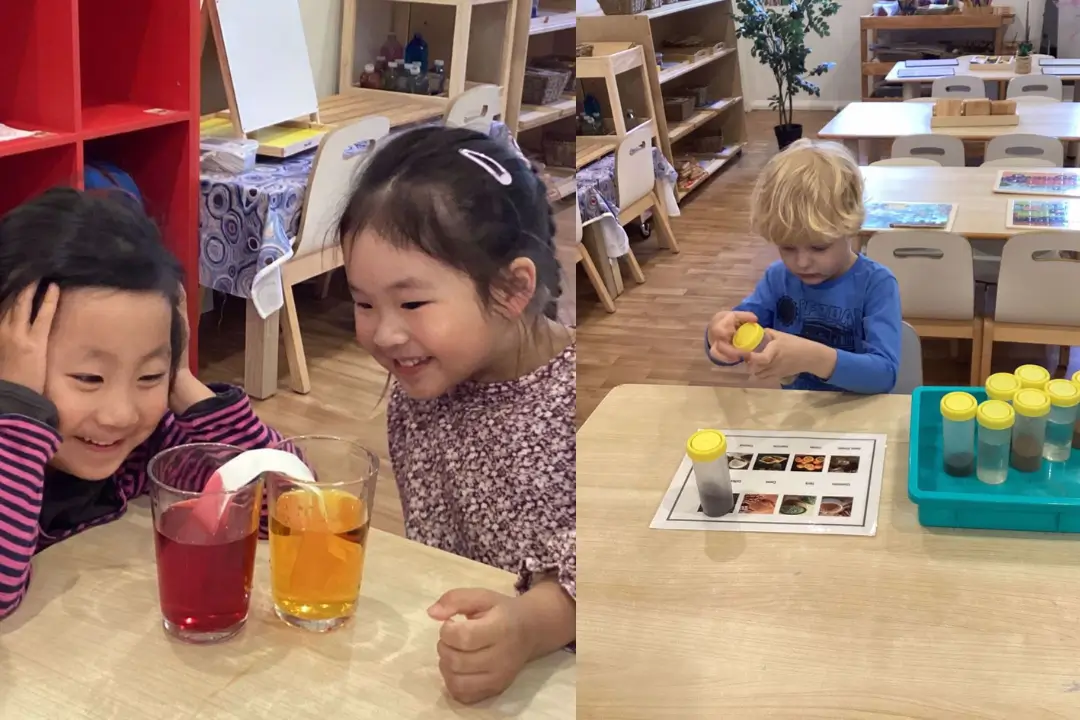
Provide clear cups of water and primary food colouring. Children mix colours and observe new colours forming. This builds cause and effect understanding and creativity.
Add vinegar to baking soda and watch the fizzing reaction. Children enjoy the bubbles and sound while learning about reactions in a safe way.
Mix cornflour and water to create a substance that feels solid when squeezed and liquid when released. Children explore texture and states of matter.
Add food colouring to milk, then touch the surface with dish soap. Children watch the colours swirl and move. This encourages close observation.
Place cotton balls with safe scents into small containers. Children smell and describe what they notice. This builds sensory awareness and vocabulary.
Learning from the natural world
Take children on a walk to collect leaves, rocks, or sticks. Encourage them to notice colours, shapes, and textures.
Let children plant seeds and water them regularly. Over time, they observe growth and change. This teaches patience and responsibility.
Create a daily weather chart and talk about what children see outside. This supports routine and early weather understanding.
Provide soil and magnifying glasses for children to explore. They may find roots, insects, or small stones. This connects children to living systems.
Seal water in a clear plastic bag and tape it to a sunny window. Children observe evaporation and condensation over time.
Understanding living things
Use toy animals or pictures and group them by habitat, size, or movement. This supports early biology skills.
Examine real plants and identify roots, stems, leaves, and flowers. Children learn that each part has a role.
Observe insects outdoors and talk about how they move and where they live. This encourages respect for living creatures.
Use pictures or models to show how animals grow and change. Children learn about growth and time.
Building, testing, and thinking
Provide blocks or recycled materials and ask children to build a bridge between two surfaces. This supports planning and problem solving.
Ask children to build the tallest tower they can. When it falls, they try again and improve their design.
Create foil boats and test how much weight they can hold. Children explore balance and buoyancy.
Use movement games with words like forward, stop, and turn. This introduces sequencing skills.
Create and extend patterns using objects or colours. This supports early maths and logical thinking.
At Wonder Years, science is more than an activity. It helps children explore the world with confidence and curiosity. During Science Week in the Preschool Room, children take part in hands on experiments, ask meaningful questions, and learn that their ideas matter.
Science Week encourages children to explore without fear of mistakes, learn through play, build confidence as young thinkers, and develop a lifelong love of learning. These are skills we nurture in our own science-based learning experiences across our centres in Cherrybrook and Beecroft.
Every experiment, question, and discovery helps children grow into curious and capable learners.